
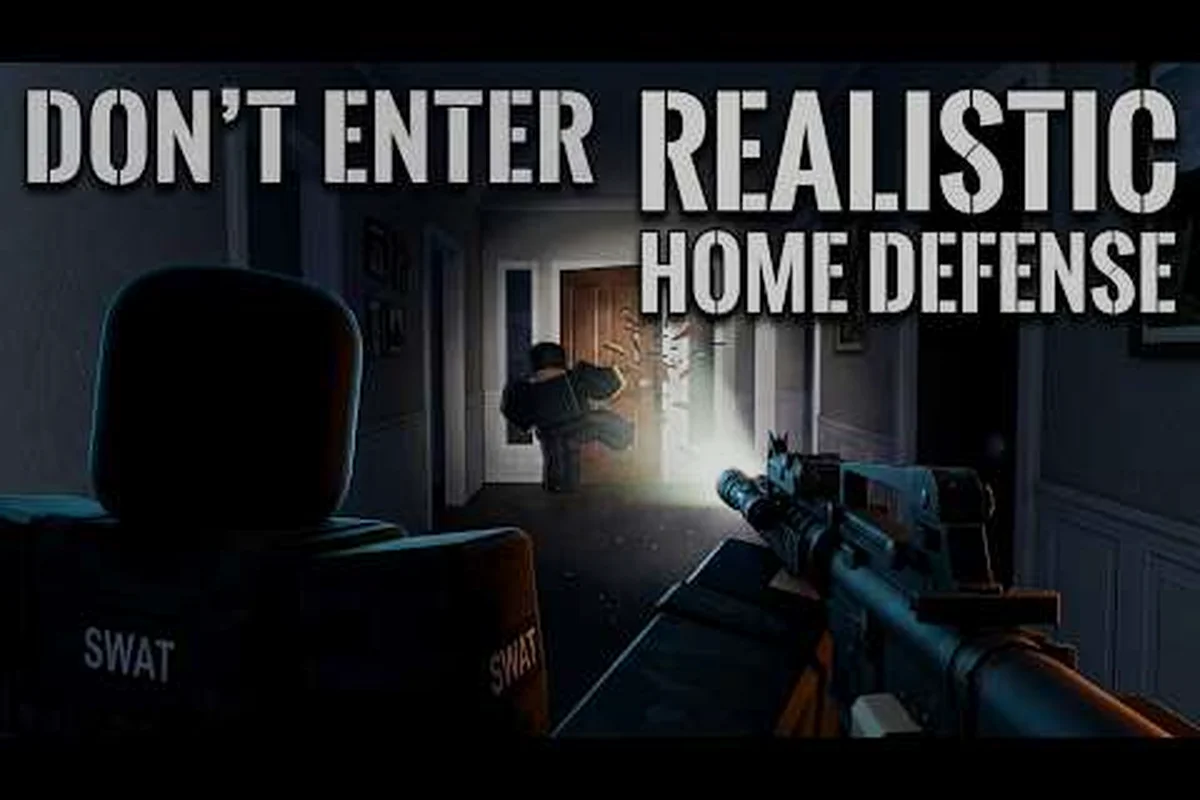
Most fights in REALISTIC HOME DEFENSE are decided in under a second, and reaction time tips are what separate a clean hold from a death in the doorway. This guide breaks down how to shave frames off your spotting-to-shooting gap so every engagement feels a step ahead.
The reason this matters is simple: the game's tight interiors and punishing recoil mean the player who reacts first usually wins outright. A defender who pre-aims a choke point beats a faster-moving attacker almost every time, because the attacker has to travel into your crosshair while you only have to click. According to community reports, the most-watched REALISTIC HOME DEFENSE clips on YouTube are almost entirely fast-reaction moments — players snapping onto targets in hallways and stairwells. You can see that pattern in Rispyif's gameplay video, where most kills happen within a second of a door opening.
How Reaction Time Actually Works in REALISTIC HOME DEFENSE Gameplay
Reaction time in this game is not a single stat you can grind — it is the sum of several small delays, and each one can be trimmed. The first is visual acquisition: how long it takes your eyes to find the enemy silhouette against a cluttered room. The second is crosshair placement: whether your reticle is already near the target or has to travel across the screen. The third is input commitment: whether you fire immediately or hesitate to confirm the shot.
Because the game uses realistic weapon handling, your recoil pattern and fire mode add a fourth delay. If you are holding full-auto in a narrow hallway, your first shots may miss high, and the correction costs you the fight. Players who switch to semi-auto or burst before a push consistently land the first bullet.
Here is a rough breakdown of where the milliseconds go in a typical engagement, based on community testing and player experience: spotting the enemy costs roughly 150–250 ms, swinging your crosshair onto them adds another 100–300 ms, and the hesitation before you commit to a shot tacks on 50–150 ms. Stack those three and you are already near half a second before the trigger even breaks — which is why a defender holding a pre-aimed angle on a doorway can drop an attacker who has to acquire, travel, and confirm, even when that attacker has faster raw reflexes.
| Delay Source | Typical Cost | How to Reduce It |
|---|---|---|
| Spotting the enemy | 150–250 ms | Brighten your screen, learn common angles |
| Crosshair travel | 100–300 ms | Pre-aim doorways and corners |
| Decision hesitation | 50–150 ms | Commit to a fire mode before contact |
| Recoil correction | 100–200 ms | Tap-fire instead of spraying |
| Reload timing | 1–2 s | Reload behind cover, never in the open |
The takeaway is that crosshair placement is the single biggest lever you control. A player with average reflexes but perfect pre-aim will beat a twitchy player who has to swing their mouse across the room. If you want a deeper breakdown of stance and movement, the movement guide covers crouch, prone, and lean mechanics that pair directly with these habits.
Why Defending the House Favors the Patient Player
When you are defending the house, you hold the advantage of knowing the map. Attackers must clear rooms blind, while you can sit on a choke point with your crosshair already at head height. That asymmetry means your reaction time effectively starts earlier than theirs — you are reacting to a sound or a silhouette you expected, not a surprise.
Community players often describe the best defenders as "boring" because they do not chase kills. They hold an angle, listen for footsteps, and let the attacker walk into a pre-aimed line. That is not passive play; it is a deliberate combat strategy that converts the map's geometry into free reaction time.
Pre-Aiming Doorways and Choke Points for REALISTIC HOME DEFENSE Defending the House
The fastest way to improve your reaction time is to stop reacting at all — put your crosshair where the enemy must appear before they appear. This is the core of defending the house effectively, and it applies to every room in the map.
Start by identifying the entry angles into each room you defend. A doorway has a near edge and a far edge, and a smart attacker will slice the near edge first. If you aim at the center of the doorframe, you are aiming at empty space. Aim at the near-edge corner where a pushing player's shoulder appears first.
Here is a practical pre-aim checklist you can run before every round: confirm your crosshair sits at head height on the near-edge corner rather than drifting to the doorframe center, verify your back is against a wall so only one or two entry angles remain live, and check that your weapon is fully loaded before you commit to the hold. The order matters — head height first, cover second, ammo last — because a center-mass crosshair forces you to flick upward on contact, adding roughly the same 100–200 ms penalty that edge pre-aiming is designed to erase. Run this checklist during the freeze time of every round until it becomes automatic, and treat any round where you catch yourself holding a center-door angle as a failed rep rather than a near miss.
-
Pick one room you can hold alone and learn its three entry angles.
-
Place your crosshair at head height on the most likely entry edge, not the center.
-
Keep your back to a wall so you only have one or two angles to watch.
-
Reload only when you are behind hard cover, never while holding an angle.
-
Listen for footstep audio and pre-fire the corner if you hear a sprint.
The difference between center-door aiming and edge aiming is dramatic. In a narrow hallway, an attacker crossing the frame is visible for only a fraction of a second at the center but appears earlier at the edge. Pre-aiming the edge buys you roughly 100–200 ms of extra decision time, which is often the entire fight.
Building a Hold Routine That Shortens Your Gap
A hold routine is a repeatable sequence you run every time you take a position, and it removes hesitation from your first contact. The routine should be short enough to complete in a few seconds: check your fire mode, confirm your crosshair height, and settle your movement so you are not drifting when the enemy appears.
Players who move constantly while holding an angle lose reaction time because their own movement blurs the screen and shifts their aim. Settle into a crouch or stand-still hold, keep your reticle steady, and let the attacker come to you. The hallway defense tactics guide expands on room-clearing and squad positioning if you defend with teammates.
Reading Push Timing in REALISTIC HOME DEFENSE PvP Tactics
Reaction time is not only about speed — it is about anticipation. In PvP tactics, the player who predicts when a push is coming reacts faster because they are already braced. Reading push timing turns a surprise into a prepared engagement.
Attackers telegraph their pushes in predictable ways. A sprint sound that suddenly stops usually means the player is about to peek. A grenade or flash thrown into a room signals an immediate entry. A long silence after a firefight often means the enemy is rotating to a different entrance.
Use this table to convert common audio and visual cues into faster reactions: each cue maps to a specific pre-planned response so you are not deciding mid-fight. For example, when sprinting footsteps stop, the table tells you to hold your angle rather than reposition — because a stopped sprint almost always precedes a peek, and moving resets your crosshair placement. Pairing each cue with one rehearsed action shaves the decision-making delay that costs you the opening trade in a home defense hold.
| Cue | What It Usually Means | Your Reaction |
|---|---|---|
| Sprinting footsteps stop | Enemy is about to peek or pre-aim | Hold your angle, do not reposition |
| Door opens slowly | Careful entry, likely aiming at center | Aim at the near edge, stay still |
| Flash or smoke lands | Immediate push behind it | Back off one step, re-aim the entry |
| Multiple footsteps | Group push, spread angles | Call it out, hold the widest angle |
| Silence after contact | Rotation to another door | Check your flank, reset crosshair |
The most common mistake is repositioning the moment you hear something. Every step you take resets your crosshair placement and adds delay. If you already hold a good angle, the correct response to a sound is usually to stay put and tighten your aim, not to chase the noise.
Deathmatch Mode as a Reaction Time Gym
The deathmatch mode is the best place to train reaction speed because respawns are fast and engagements are constant. Treat each deathmatch session as a drill rather than a score chase: pick one habit, such as pre-aiming every corner, and repeat it until it becomes automatic.
A useful drill is the one-tap rule. In deathmatch, force yourself to land the first shot before firing a second. This trains you to value crosshair placement over spray control and builds the muscle memory that carries into defending the house. Players who grind deathmatch with intent improve noticeably faster than those who simply play for kills.
REALISTIC HOME DEFENSE Combat Strategy: Shortening the Spot-to-Shot Gap
A complete combat strategy for faster fights combines hardware, settings, and in-game habits. Most players focus only on in-game skill, but your sensitivity, field of view, and display settings directly affect how quickly you can acquire a target.
Start with sensitivity. A sensitivity that is too high makes small corrections overshoot, while one that is too low forces large arm movements. The sweet spot lets you turn roughly 180 degrees with a comfortable swipe while still making fine adjustments at range. Test it in deathmatch by tracking a moving target across a doorway.
Settings that commonly help reaction time include sensitivity and DPI pairings tuned to the same 180-degree swipe you tested in deathmatch, since a low in-game sensitivity paired with high mouse DPI can feel twitchy at close range even when the raw turn distance matches. Pair that with raw input enabled and mouse acceleration disabled, because Windows pointer smoothing adds a variable delay between your hand movement and the on-screen crosshair — the exact gap you are trying to shrink when a defender steps through a doorway.
-
A field of view wide enough to see door edges without distorting your aim.
-
Consistent frame rate — stutters cost more reaction time than any setting.
-
A crosshair with a small, high-contrast dot so your eye locks to the center.
-
Audio cues turned up, since footsteps often arrive before the visual.
Beyond settings, the biggest strategic gain comes from map knowledge. Knowing which rooms have one entrance and which have three lets you choose holds where you only need to watch a single angle. A one-angle hold is dramatically faster to react in than a three-angle hold, because your attention is not split.
Managing Reloads and Fire Mode Under Pressure
Reload timing is a hidden reaction-time killer. If you empty your magazine while holding an angle, you are helpless for one to two seconds — an eternity in a close-quarters fight. The fix is to reload proactively: top off behind cover, after a kill, or whenever the room goes quiet.
Fire mode matters just as much. Switching to semi-auto before a long hallway hold gives you a precise first shot, while full-auto suits a close stairwell where the enemy appears at point-blank range. Decide your fire mode before contact, not during it, because switching mid-fight costs the exact milliseconds you are trying to save.
REALISTIC HOME DEFENSE Mechanics Overview: What Actually Slows You Down
A quick mechanics overview helps you understand which systems are working against your reaction time. The game models realistic weapon handling, which means recoil, reload speed, and fire rate all behave differently from arcade shooters. Your first shot is usually accurate, but sustained fire climbs, so the fastest kill is almost always the first clean shot.
Movement also affects accuracy. Sprinting into a room leaves you unable to shoot accurately for a moment, which is why attackers who sprint through doorways are easy targets for a settled defender. Crouching or standing still gives you the tightest first-shot accuracy.
| Mechanic | Effect on Reaction Time | Best Practice |
|---|---|---|
| Recoil climb | Forces correction after first shots | Tap-fire, reset between bursts |
| Reload speed | Creates a helpless window | Reload behind cover only |
| Sprint accuracy penalty | Delays your first accurate shot | Stop before you shoot |
| Fire mode switch | Costs a moment mid-fight | Set it before contact |
| Footstep audio | Gives early warning | Hold still and listen |
Understanding these mechanics lets you build a playstyle around them rather than fighting them. The table above is really a priority list: the reload window is the deadliest of the four penalties, because a defender caught mid-reload behind an open doorway has no accurate first shot and no way to cancel the animation — which is why the reload-behind-cover rule matters more than any aim tip. Tap-firing also plays directly into the first-shot accuracy model; a defender who lands one clean shot and resets beats an attacker holding the trigger through recoil climb every time. A defender who taps, reloads safely, and never sprints into their own angle will consistently out-react an attacker who sprays and repositions constantly.
Practicing With Intent Each Session
Improvement comes from deliberate practice, not volume. Before each session, pick one reaction-time habit to focus on — pre-aiming edges, settling before shooting, or reading push cues — and hold yourself to it for the whole session. Review what went wrong after a death and ask whether it was a reaction failure or a positioning failure.
Most deaths in defending the house trace back to crosshair placement, not raw reflexes. If your reticle was on the doorway edge when the enemy appeared, you win; if it was drifting, you lose. Fixing placement fixes most reaction problems without any change to your actual speed.
Frequently Asked Questions
How can I improve my reaction time in REALISTIC HOME DEFENSE?
The fastest gains come from pre-aiming doorway edges at head height and settling your movement before contact. Crosshair placement removes the need to react quickly at all, because your reticle is already where the enemy appears. Pair that with tap-firing and proactive reloads to cut the remaining delays.
Is deathmatch mode good for practicing reaction speed?
Yes. Deathmatch mode offers constant, fast engagements with quick respawns, making it ideal for drilling one habit at a time. Focus on landing the first shot before firing a second, and treat each session as practice rather than a score chase to build lasting muscle memory.
What sensitivity should I use for faster fights?
There is no universal number, but a good starting point lets you turn about 180 degrees with one comfortable swipe while still making fine adjustments at range. Test it in deathmatch by tracking targets across doorways, and adjust until small corrections feel precise rather than twitchy.
Why do I keep losing hallway fights even when I see the enemy first?
Seeing the enemy first is not enough if your crosshair is drifting or your fire mode is wrong. Most losses come from center-door aiming, sprinting into your own angle, or spraying instead of tapping. Settle your movement, aim the near edge, and commit to a fire mode before contact.
Does defending the house give a reaction-time advantage?
It does, because defenders know the map and can hold pre-aimed angles while attackers clear rooms blind. That lets your reaction effectively begin earlier than the attacker's. The advantage disappears if you reposition on every sound, so hold your angle and let the push come to you.
Faster fights in REALISTIC HOME DEFENSE come down to preparation more than raw reflexes. Pre-aim the edges, settle before you shoot, read the push cues, and treat deathmatch as a drill — do those consistently and the gap between spotting and shooting shrinks on its own.